Thursday, May 19, 2011

Foo Fighters - Wasting Light


Breaking into the music scene a drummer, Dave Grohl has always had a good sense of timing, and not just in a siss-boom-bah sort of way. He joined Nirvana just as the band was on the brink of becoming a living legend. He formed Foo Fighters when it seemed like all hope for a happy ending had died with Kurt Cobain. And now with Wasting Light, Dave Grohl reminds us that it's time to put aside all that has never been put behind. It's time to lay to rest our regrets and enjoy the moments of our lives as they pass, keeping whatever time signature they should. What does all of this have to do with the music that Foo Fighters has made for this release? Balance and ambition. Aside from being one of the greatest albums I have ever heard, Wasting Light has managed to recapture the life that rock n' roll once led. In a time when most bands are content continuing to crank out loud-and-proud jock rock, Foo Fighters is pushing the envelope... back across the table. This band isn't selling out, they're buying in. From track to track, Wasting Light sounds like a band that has been that has been through hell and come out the other side. Albums like this one make me wish more bands could band together long enough to outlive the individual egos of its members. What will The Killers sound like in 2025? I really hope that we'll get to hear that. In the meantime, I am content to know that I was alive when the Foo Fighters' Wasting Light, one of rock's greatest releases, hit the racks.

I watched a concert of Foo Fighters playing Wembley during their last tour, and I imagine my feeling was the same as my parents' when seeing Elvis on Ed Sullivan for the first time. Every piece of every performance of every member of the band was just as tight live as it is on tape. It's obvious that this is a band of guys who will never be content just being the best. They put in a lot of hours, and it shows. But more than that, they put time into the band, not just the music, because they've discovered that a happy band plays better music. They're not tied to their emotions. They're free to do write a ballad, or an arena anthem, or even a metal-influenced thrasher, because they've come to peace with their pasts and their problems. It's only May, but Wasting Light may well be my best buy of the year, if not the decade. The Foos don't sound like they're fighting anymore; they're just feeling the groove of getting older, wiser, and better as musicians.

There's really not a throw-away track on this album. Every song sounds just as thoughtful and cared for as the rest. Frankly, if bands weren't forced to put out singles, I'd be hard-pressed to say which songs on Wasting Light aren't contenders as singles. For me, this album sounds as fresh, yet familiar, as any of Queen's work while they were on top. At this late point in the Foos' careers, so much of their sound almost seems self-referential, it's hard to say where they're taking cues their cues from; any past influences have long since become infused into Foo Fighters' unique style and sound. One thing is clear to me after hearing Wasting Light that was not clear to me before, this band won't quit, so the best is still to come. And at this point, I don't care where their music takes these guys, as long as they keep bringing us along for the ride. Fast, fun and full of energy, Foo Fighters never fail to deliver. And again, so much of that is just good timing.

Highlights: "Dear Rosemary" and "I Should Have Known"

Tuesday, May 3, 2011

Mick Flannery - White Lies


Mick Flannery is an Irish songwriter. I specify "Irish", not because all of his songs have to do with Saint Patrick or leprechauns, but because his Irish upbringing is very much relevant to the texture of each tune, much in the same ways as early U2 work. The songs he sings are personal, as if each lyric were lifted right from the pages of Flannery's own journal, written by the diminishing glow of the moon with a cigarette burning unattended and a shot glass resting overturned on the bedside table. At least, that's how I imagine the setting. From the opening chords of "Safety Rope", you know what you're in for on White Lies. If you were a fan of Flannery's earlier work (which you should be), you'll hear a significant growth in style between Evening Train and this album. You don't have to listen hard at all to hear Flannery's influences coming through either: Tom Waits and Bob Dylan. All of these songs tell stories of the seedier variety, as the material of Tom Waits has for decades. Like myself, Flannery also had a taste for Charles Bukowski, which really isn't much of a stretch for a Tom Waits fan.

Often preferring somber over something more upbeat, Flannery's voice compliments the emotional longing of his lyrics. I get the sense that this is a guy who's had a lot of time to think about the kinds of questions most of us choose not to think about, such as considering the corruption of our own souls at our own hands. I am reminded a lot of Damien Rice, in that regard, as well as due to the soft female backing vocals on many of the tracks. I find that those types of more cerebral albums tend to take a little longer to sink in, but often result in a much deeper connection than a poppy-party-people-pleaser-type album. And that rule has certainly been true with White Lies. Mick's music is brooding, brash and beautiful. Can't recommend his stuff enough.

Highlights: "Safety Rope" and "California"

Wednesday, September 15, 2010

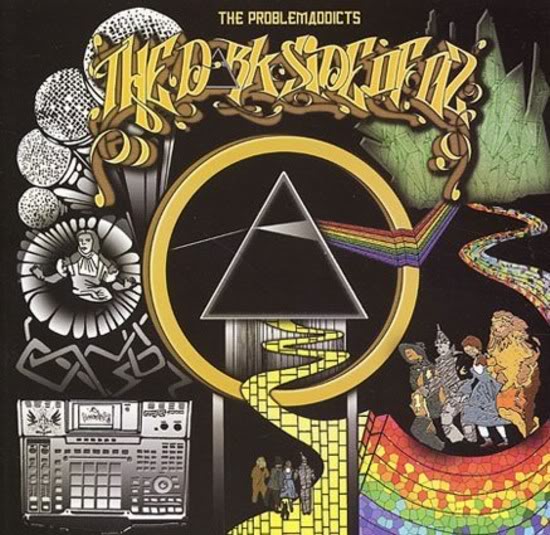
The Problemaddicts - The Dark Side of Oz


A mere two years following their founding in 2006, 6-man crew The Problemaddicts undertook a project that pulled together two albums that had already coexisted comfortably in smoky dorm rooms around the world for more than 40 years: Pink Floyd's Dark Side of the Moon (1973) and "The Wizard of Oz" soundtrack (1939). As one might imagine, such an unoriginal pairing could produce one of only two outcomes: Groundbreaking or Heartbreaking. As it should already be obvious from its inclusion here, the release of The Dark Side of Oz put to rest any question of The Problemaddicts falling prey to any pitfalls that may have led to the latter. Never before has a 40-year-old concept sounded so fresh and current.

Much more than a mash-up of already-made masterpieces, The Dark Side of Oz takes elements from many source materials, including interviews with Pink Floyd, an anti-drug George W Bush speech, and plenty of other playful audio pieces-parts, which all come together with precision-cut production similar to Gorillaz or Handsome Boy Modeling School. What The Problemaddicts bring to the table is a wholly-new hodgepodge of hedonistic helpings of hip-hop goodness; and it'll keep you coming back for more. The beats are built organically over repeating riffs mined from Dark Side of the Moon. The rhymes are dropped like pennies from heaven, falling end-over-end, flipping and turning, becoming more and more dangerous as they approach the masses below, yet brilliant and rich nonetheless. Think Wu-Tang. No, I'm not really comparing The Problemaddicts to the untouchable greatness of The Wu (R.I.P.O.D.B.), but the lyrical flow of The Dark Side of Oz lays a little looser in the groove than much of today's click-tracked, on-the-beat borefests. There's something "old school" about it, like something you might've seen stacked between Spice 1 and Run DMC on "Yo! MTV Raps" back in the day.

This is an immensely complex album that could have imploded at a hundred different points along the production path, but it didn't. (Just one advantage of being addicted to problems, I guess.) Instead, this wise-cracking crew from Massachusetts (yeah, you read that right - MASSACHUSETTS) took on the task of breathing new life into old classics, and as Dr. Frankenstein would say, "It's alive!" Best of all: You can preview the whole album right here: http://www.last.fm/music/The+Problemaddicts/The+Dark+Side+Of+Oz. And like your old standardized test instructor used to warn before each section, "Do not skip ahead". This album is like the Yellow Brick Road, the fun is in the journey. The inclusion of poppies are entirely up to you.

Highlights: "Somewhere" and "Home"

Friday, August 20, 2010

Lost In The Trees - All Alone In An Empty House


Shh. As the title of the album suggests, this is best heard "All Alone in an Empty House". Normally, I tend to be drawn to simple music that makes the most of its melodies, whose sum truly outperforms its parts. But then there are multi-instrumental masterpieces like this one that start simple, before stepping outside and bringing back a bit more of the world to share. Lost In The Trees captures a brilliance and beauty that has been left behind by most of their contemporaries. The songs that make up All Alone in an Empty House aren't so much subdued as they are subtle. Sure, there's a quietness to each song that can't be denied, but there's also a creativity that can't be contained. It's a creativity that is both calculated and at the same time completely carefree. Between the finger-picked guitars and swelling orchestration, the balance that exists extends beyond the well-trodden plane where most performers plant their feet. This album is not so much a glimpse into the mind of the musician as it is a black hole of human emotion that sucks in its surroundings like a banshee breathing in reverse, signaling signs of life rather than impending doom.
As a classically trained composer at the Berklee School of Music in Boston, MA, frontman Ari Picker plows through each song like a balladeer on Benzedrine, melancholic and on a mission. Each song seems to draw power from places most of us can't even point to. To call Mr. Picker a "prodigy" would be to say that The Beatles were "experimental". Much in the same way that Lennon and company pushed the limit of pop music, Lost In The Trees tests the tried-and-true notions of music itself. Attesting to its brilliance is the fact that All Alone In An Empty House was originally recorded and released back in 2007, while Picker was still in school; however, since being signed to Anti- records, the album has been given a grand re-entrance on a much more sizable stage, complete with additional songs and remastering. While there are certainly some similarities with new label mates The Swell Season, Lost In The Trees stands alone in their own realm, in their own room, in their own empty house, as a troubled soul with too much talent to waste and too much time to reconsider the wrongs in life that were never made right. These songs haunt my soul as assuredly as they inspire it. Hearing it for the first time is like waking up from a dream and finding that the other side of the bed has been abandoned: Freedom filled with fear. You place your hand upon your partner's still imprinted pillow, and the band begins to play...

Highlights: "Walk Around The Lake" and "Fireplace"

Wednesday, August 11, 2010

J Roddy Walston And The Business (self-titled)

All hail the rebirth of Southern Rock sensibilities! J Roddy Walston fuses together dirty blues beats and even dirtier rock runs, creating a raw and raucous album that rolls in like a rush of blood to all the right places. J Roddy Walston and the Business's debut album is everything I ever wanted out of a Jack White album, minus Jack White. Instead, Walston and his Business partners come across as something of a Black Crowes/White Stripes love-child. The resulting album is track after track of loud, proud, pissed-off, right-on rock and roll. You can almost hear the hoarseness growing in J Roddy's vocals as the album advances.

J Roddy Walston and the Business just may be the greatest "bar band" of all time. From the opening piano part of "Don't Break the Needle", you just NEED a beer to fully appreciate all that this album has to offer: a whole damn house party packed into a 37.7-minute mesmerizing, messy masterpiece. The vocals veer high and low like a man who's visited the verge of Hell in his earlier days and now vacations there during down times. The guitars are gritty, gained-up and grab hold of your gut like a pitbull that can't-for-the-love-of-god let go. The percussion pivots from piano to 5-piece kit without so much as a pause, giving the band a broader base by which to build their own brand of southern symphonies. It all comes together in a cohesive collaboration of sonic screams sung to down-home ditties. This kind of rock n roll is why vinyl records and jukeboxes still exist. This isn't one of those albums that I want everyone to hear; it's one of those albums that everyone needs. I repeat: You need this album. Go get it! Now. I promise you won't be disappointed.

Highlights: "Don't Break The Needle" and "Don't Get Old"

Tuesday, June 29, 2010

Lissie - Catching A Tiger


It's a rare occasion that I stumble upon a new artist whose voice grabs hold of me so tightly as Lissie's voice; it's raspy, sexy, pitch-perfect, and yet not at all pretentious. On her debut album, Catching A Tiger, Lissie lays the groundwork for a career as open as the rural landscapes she recounts in her songs. She could be the next Cheryl Crow. She could turn country and become a new Jewel. Hell, given some of her cover song choices I've heard, "Bad Romance" (Lady GaGa) and "Nothing Else Matters" (Metallica), it's really hard to say where she's headed next. For the time being, I'm hoping that she just continues to pump out more of the Southern-infused folk rock that makes up this entire album. At times beautiful, at times grungy, at times as classic as classic rock gets, Lissie spans the spectrum of musical influences without sounding anything like them. Okay, that's not entirely true; anyone with an ear can hear some distinct throwbacks to bands like Lynyrd Skynyrd, Fleetwood Mac, John Cougar Mellencamp, and others. Hailing from Rock Island, Illinois (pop.39, 684), Catching A Tiger echos the small-town/big-city playfulness that is so prevalent in its songs. Whether you like blues, rock, pop, or folk, you will find something new to love in this album and this artist. I really just can't say enough good things about her. I'm expecting great things in the future from first-name-only Lissie.

Highlights: "When I'm Alone" and "Everywhere I Go"

Thursday, April 1, 2010

Elliott Smith - Figure 8


Figure 8 is an important release in the Elliott Smith discography for a number of reasons: 1) It's the last record he released before his death, 2) It's his last release under his DreamWorks contract, 3) It's his most musically exploratory release , and 4) It's the last release before Smith's drug dependencies began to interfere with his music, rather than just influence it. For those of you who've never listened to an Elliott Smith album before, you're in for a real treat. He plays unfolky folk music. He plays unrockish rock music. He plays unpunk punk music. His approach to songwriting was guided by two major components: melody and mood. As such, it's not hard to hear the Beatles fan in him hanging out in the corner of almost every composition. Smith's lyrics really leaned more toward poetic than pop aesthetics, delivered in a whispery rasp that he developed during the later years with his previous band, Heatmiser. (If you do decide to wander into the Smith back catalog, be warned: Though Smith was a frontman for Heatmiser, his solo work bears little resemblance with that band's five releases, except for maybe Mic City Sons.) And while I have a special place in my heart for all of Elliott Smith's albums, Figure 8 is my favorite. It's a bit like saying that I love this orange more than that one, but there it is. Although sometimes criticized for being "too glossy", especially for a guy whose entire repertoire reveled in its rough-around-the-edges executions, Figure 8 seemed to capture a moment in time when Smith was working at expanding his sound with experimental abandon. Having just come off the huge popularity of X/O (which had followed an Oscar nomination for "Miss Misery" from the Good Will Hunting soundtrack), Smith intentionally nudged this new material in another direction. Swelling orchestrations, intricate chord progressions, and meticulous melodies make Figure 8 one of the most beautiful albums ever recorded. Like a modern-day Simon and Garfunkel humming harmonies with himself.

Highlights: "Son of Sam" and "Everything Means Nothing To Me"