Tuesday, November 27, 2012

Soundgarden - King Animal


It's official: They're back!  With the release of King Animal, Soundgarden has again secured a slot among music's most wanted.  I'll be honest - I was a little scared of what this album was gonna sound like, but then I saw the band reunite in Dallas, in preparation for their Voodoo Fest headlining gig.  After that show, there was no doubt in my mind that Soundgarden's member meant business.  Kim Thayil's leads were still open-tuned and thunderous.  Ben Sheppard still slung his bass down below the belt, which is exactly where it could be felt in the crowd as well.  Matt Cameron hasn't missed a beat, as anyone who's heard a Pearl Jam album since 1998 should already know - that guy is just a machine.  And Chris Cornell, well, that voice is as unmistakeable and ear-splitting as ever.  Although they didn't play any new material at the show, there was no doubt that whatever they were working on was going to work out just fine.  The old material they did play sounded even better than it did in 1996, when I saw them at Lollapalooza, just before their breakup in 1997.  And for anyone counting, that was 15 years ago!  And for anyone listening, those 15 years didn't matter one bit.  King Animal serves as well as a follow up album to Down on the Upside as if it had been released before the breakup.  In fact, I recently listened to the two albums back to back, and the transition between albums is seamless.  It moves in exactly the same direction as I would have expected in '97, except that the subject matter has matured, giving the whole sound a bit more sophistication.  Seriously, just put the all their albums on shuffle and see if you can detect any dissension in the sound.  You won't.

From the get-go, "Been Away Too Long" says it all: "I only ever really wanted a break - I've been away for too long."  Chris Cornell has always had a way of just getting straight to point.  And musically, the track comes crashing in like a psycho ex-girlfriend with a score to settle - pounding down doors, bashing in windows and torching every shred of life in sight.  That old balance of balls and balladry is perfectly in sync.  While Thayil's leads lure you in one direction, Cornell's lyrics break like a bottle over the head from behind.  This is the Seattle sound that even Seattle couldn't seem to sound like since Soundgarden left the scene.  Like every Soundgarden album since Ultramega OK, King Animal attacks in waves like a pack of wild dogs circling their prey.  So just when "Bones of Birds" and "Taree" have you settled in, "Attrition" comes out from the shadows to swallow you whole, only to lull you back into a false sense of security again with "Black Saturday" and "Halfway There" - two tunes that sound stripped straight from Cornell's Euphoric Morning sessions.  Of course, it's the tracks like "By Crooked Steps" and "Eyelids Mouth" that bring back what Soundgarden has always been best at: Chugging, churning chords backed by searing solos and raunchy riffs.  The album's heavier-than-hell moments always threaten to break free and head for the heavens, only to fall back to earth like Icarus with wounded wings.  That's the push-pull dynamic that this band has always been about.  Like watching the sun rise from behind bars, the moments of beauty are always beaten back by ball-peen hammer-ons and equally blunt lyrics.

If you weren't a Soundgarden fan before, you might not find anything here that will change your mind; however, if the breakup of the band in 1997 left you longing for one last ride down the rabbit hole, then consider King Animal your red pill relapse.  See you at the bottom, if you survive the trip.

Highlights: "Been Away Too Long" and "Bones of Birds"

Wednesday, August 8, 2012

Anders Osborne - Black Eye Galaxy


If you've ever heard of Anders Osborne before, forget what you know. If you haven't heard his name before now, go out and get everything you can find, soak it all in, then forget what you know. Sure, Black Eye Galaxy still feels like an Anders Osborne album with saturated burgeoning blues/rock riffs set to howling lyrics of introspection; however, musically, Osborne has opened up his tone to include a bit more grit and growl than in his previous efforts. If the first two tracks, "Send Me a Friend" and "Mind of a Junkie", don't hit you over the head hard enough to hone in, let's just come right out with it: Anders Osborne is overcoming addiction, and this is his journal. So by the album's fifth track, "Black Tar", you start to see the clouds and confusion parting, only to be pulled right back in, riding high, before coming back down, depressed and insecure. And the ride resumes.

If you have even a basic understanding of addiction, you understand that the disease exists on two dimensions: heavenly highs and languishing lows. Black Eye Galaxy (the album) exists much like the actual Black Eye Galaxy, two incredible forces crashed into one another and pulling in different directions, where only one will survive. Anders no doubt understands the gravity of his addiction, penning lyrics like "I'm weak, Lord, but I won't bow down" and "Please, somebody, save me from my crazy mind". This isn't a musician in a studio struggling to write a great hook; this is a man using his music to overcome the struggle for his very soul. The highs and lows of the song sequence seem to suggest a cycle of abuse, rehab, relapse and finally redemption.

Musically, few performers have as diverse and deep pockets to pull from as Mr. Osborne. Like hidden gems hanging around the fringes, Black Eye Galaxy incorporates everything from tribal beats to reggae rhythms fused together to fit Anders own blend of bruised-and-battered-blues - like a scar on a supermodel. This album draws just as much inspiration from the ugly as the beautiful, the light as the dark, the black as the blue. As any junkie can tell you, there is no recipe for redemption. As any musician can tell you, there are no instructions for inspiration. Much like Dark Side of the Moon, Black Eye Galaxy deserves a straight-through listening to truly appreciate the tale of turmoil and turnaround relayed through the recording. As any readers of mine might know, honesty and emotional integrity are two key features of almost every album I consider "just plain good music", and Anders serves them up in spades... and hearts.

Highlights: "When Will I See You Again" and "Louisiana Gold"

P.S. This is my favorite album of 2012. I dubbed it as such on my first listening in March, and it still holds the title today.

Friday, September 16, 2011

Red Hot Chili Peppers - I'm With You


Anticipation laced with apprehension. That was how I felt in the months leading up to Red Hot Chili Peppers' newest release, I'm With You. Why? For starters, the band hadn't released a studio album since 2006. Secondly, I wasn't a huge fan of the last album. Lots of great material, but also a lot of so-so stuff. To be fair though, these guys could jam in a room, hit record, and the result would be better than most bands' opus album. Now, the single most important reason for apprehension was the departure of RHCP guitarist John Frusciante in 2009. Frusciante had joined the band just before Mother's Milk was recorded, but it wasn't until the release of Blood Sugar Sex Magik that his influence in the band's sound could be fully felt. And it changed everything. RHCP became a household name, while occupying a genre all their own. They were funky, bluesy, poppy, jazzy and rockin' all at the same time. While I had heard of the Chili Peppers prior to Blood Sugar Sex Magik, I didn't pay attention until after. Something about Frusciante's playing style hooked me immediately. It's a really loose style that sits perfectly into the mix between Chad Smith's flawless drum line, Flea's funky bass grooves, and Anthony Keidis's rap-slapped singing. It is a guitar-feel that I felt the Chili Peppers might never be able to fill again.

My opinion wasn't unfounded, as this wasn't Frusciante's first departure from the band. Back in 1994, he left just as the band was reaching its peak, uncomfortable with the newfound fans and success. His replacement? The more-than-capable Dave Navarro of Jane's Addiction fame. Initally optimistic of that lineup, the album felt like an experiment more than an album. I love Navarro's playing. I love the Red Hot Chili Peppers. I did not love the combination of the two. Again, to be fair, there are plenty of great songs on the albums, many in fact, but it doesn't feel like a Chili Peppers album to me. The funk got a little lost along the way. In its place, there's a harder edge and aggression, which rises and falls like an addict finding his next fix. The reality of the recording process of One Hot Minute wasn't far off. Keidis was apparently fighting some pretty ferocious demons, and their damage was darkening everything and not discussed by anyone. The result is a manic mashup of styles, genres, and themes.

So, now you have a little background to better understand my aforementioned apprehension. But when the album dropped, all reservations were washed away. I'm With You is the Red Hot Chili Peppers album I've been waiting for since Blood Sugar Sex Magik. I don't know if Josh Klinghoffer's addition to the band enticed them to branch out or become better musicians, but there is no doubt in my mind that he makes the whole band sound better. Everyone has their mark on the music, but without marking it up with personal asides and solo opportunities. Every sound in the mix serves the song, which gives the whole album a sense of stripped-down directness in its delivery. So, in keeping with that ideology, allow me to be so bold if you will: You need to get this album now! Next album? No apprehension here.

Highlights: "Brendan's Death Song" and "Happiness Loves Company"

Tuesday, June 14, 2011

Faith No More - Angel Dust


This was my favorite album for many years. While I had enjoyed Faith No More's third album, The Real Thing, it wasn't until Angel Dust arrived in 1992 that I put all of my musical faith into Faith No More. Angel Dust changed everything for me musically; it opened my eyes to genre combinations I couldn't have imagined until I heard them here. I give Mike Patton a lot of credit, as this was the first Faith No More album on which he was able to contribute as a songwriter. On The Real Thing Patton was something of a hired gun, just a singer singing songs someone else had already arranged. In just three years between albums, Mike Patton returned to his former band, Mr. Bungle, and cut a new album with them, before taking what he had learned and lending it to Angel Dust. Experimentation became the norm. Samples held together the structure. Nothing was sacred. No one was safe.

Incorporating everything from metal and classical, Angel Dust sounds like nothing else, before its release or since. Perhaps that's why Kerrang! magazine named Angel Dust "the #1 Most Influential Album of All Time". How big of an honor is that? Let's put it this way: Nirvana's Nevermind was listed #2, followed closely by Black Sabbath and Metallica. That's good company to keep and even better company to beat. So, what is it about this album that muscles all the masters of metal into submission? Originality in the form of 100% unbridled, beautiful ugliness. If that description seems at all strange or exaggerated, just take a look at the front and back cover art (see above). The front is beautiful. The back is ugly. The front is polished. The back is raw. The front is majestic. The back is morbid. That is the promise, and Angel Dust delivers. Faith No More twists and turns conventional music to make something that isn't just improved, it's entirely new. Angel Dust is the gun in the knife fight, and it's aimed right at the gut.

When the banging first begins on "Land of Sunshine", you're immediately aware that something has gone awry. This isn't the Faith No More of before, and this band isn't aiming to please, they're aiming to kill. Direct hit. After hit. After hit. A number of tracks became singles, and those that didn't became fan favorites. Whether it was played on Top 40 radio or exchanged on mixtapes, every song was something worthy of extended exploration. While "Midlife Crisis" pits a Simon and Garfunkel sample in the verse against a Beastie Boys sample in the bridge, "Everything's Ruined", songs like "RV" explored entirely different avenues from seemingly distant planets. Take the tour - you'll be happy you did.

Highlights: "Everything's Ruined" and "A Small Victory" ("Jizzlobber" for the brave)

Thursday, June 2, 2011

Soul Asylum - Grave Dancers Union


Having paid their band-on-the-fringe dues, Soul Asylum broke big in 1992 with the triple-platinum release of Grave Dancers Union, their sixth official album. Yes, sixth. Like I said, they paid their dues, and you can hear it on every track. Lead singer/songwriter Dave Pirner screams as if he truly may be trapped in a soul asylum of sorts. Some cuts cut through while others just seem to seep out slowly, but they come together in wonderful ways you wouldn't always expect on a triple-platinum album. Normally, when an album sells that well, it's full of fun, frolicking guilty-pleasure goodness, like Hootie and the Blowfish's debut album. But this isn't that kind of album. Soul Asylum actually delivers on their name and shows a little of their soul in these songs.

Hailing from the Minneapolis (same as indie rock legends Husker Du), Soul Asylum's sound combines a number of influences in unfamiliar fits and stops. While songs like "Somebody to Shove" unleash a no-holds-barred barrage of lyrical bullets, there are others like "The Sun Maid" that make me yearn for an open park and a picnic basket. Even more so than the emotion in Pirner's vocals, it's the weight of his words that attracted so many listeners. And while many now credit the band as an early contributor to the grunge movement of the early 90s, it was not until after that movement was underway that Soul Asylum got the credit they deserved. In fact, many early reviews drew direct comparisons to the singing/screaming similarities between Dave Pirner and Nirvana's notorious Kurt Cobain, despite Soul Asylum having been formed nearly a decade before Nirvana went from nobodies to the next great thing with the release of Nevermind. By the time Soul Asylum finally broke out, there were rumors the band was already breaking up. As the band completed recordings for Grave Dancers Union, half of the tracks had one drummer and the other half had another. It may even be the tension of that internal struggle that we hear in these recordings. Every song is well-produced and polished, but still raw in its energy and emotion, like a Harley Davidson on an open road. The album's massive success led many to suggest that Soul Asylum had merely sold their souls, or at the very least, sold out. If this is the sound of selling out, I wish more good bands would.

Highlights: "Runaway Train" and "Without a Trace"

+ I've been emailing back and forth with Michael Beinhorn, who produced this album. This guy has produced some amazing artists throughout his career. From Red Hot Chili Peppers, Soundgarden and Korn, to Aerosmith, Ozzy and Herbie Hancock, the talented Mr. Beinhorn has heard it all, and made it sound even better. In his own words: "My own commitment is to help artists get to the place where they can be expressive- but in their own unique and personal way. Music should all be able to coexist- from the most fabricated, mechanized, pop bombast to the most personal and unlistenable." Nothing could explain the expansiveness of this album better than the man who made it. Check out his blog: http://michaelbeinhorn.net/. He gets it.

Thursday, May 19, 2011

Foo Fighters - Wasting Light


Breaking into the music scene a drummer, Dave Grohl has always had a good sense of timing, and not just in a siss-boom-bah sort of way. He joined Nirvana just as the band was on the brink of becoming a living legend. He formed Foo Fighters when it seemed like all hope for a happy ending had died with Kurt Cobain. And now with Wasting Light, Dave Grohl reminds us that it's time to put aside all that has never been put behind. It's time to lay to rest our regrets and enjoy the moments of our lives as they pass, keeping whatever time signature they should. What does all of this have to do with the music that Foo Fighters has made for this release? Balance and ambition. Aside from being one of the greatest albums I have ever heard, Wasting Light has managed to recapture the life that rock n' roll once led. In a time when most bands are content continuing to crank out loud-and-proud jock rock, Foo Fighters is pushing the envelope... back across the table. This band isn't selling out, they're buying in. From track to track, Wasting Light sounds like a band that has been that has been through hell and come out the other side. Albums like this one make me wish more bands could band together long enough to outlive the individual egos of its members. What will The Killers sound like in 2025? I really hope that we'll get to hear that. In the meantime, I am content to know that I was alive when the Foo Fighters' Wasting Light, one of rock's greatest releases, hit the racks.

I watched a concert of Foo Fighters playing Wembley during their last tour, and I imagine my feeling was the same as my parents' when seeing Elvis on Ed Sullivan for the first time. Every piece of every performance of every member of the band was just as tight live as it is on tape. It's obvious that this is a band of guys who will never be content just being the best. They put in a lot of hours, and it shows. But more than that, they put time into the band, not just the music, because they've discovered that a happy band plays better music. They're not tied to their emotions. They're free to do write a ballad, or an arena anthem, or even a metal-influenced thrasher, because they've come to peace with their pasts and their problems. It's only May, but Wasting Light may well be my best buy of the year, if not the decade. The Foos don't sound like they're fighting anymore; they're just feeling the groove of getting older, wiser, and better as musicians.

There's really not a throw-away track on this album. Every song sounds just as thoughtful and cared for as the rest. Frankly, if bands weren't forced to put out singles, I'd be hard-pressed to say which songs on Wasting Light aren't contenders as singles. For me, this album sounds as fresh, yet familiar, as any of Queen's work while they were on top. At this late point in the Foos' careers, so much of their sound almost seems self-referential, it's hard to say where they're taking cues their cues from; any past influences have long since become infused into Foo Fighters' unique style and sound. One thing is clear to me after hearing Wasting Light that was not clear to me before, this band won't quit, so the best is still to come. And at this point, I don't care where their music takes these guys, as long as they keep bringing us along for the ride. Fast, fun and full of energy, Foo Fighters never fail to deliver. And again, so much of that is just good timing.

Highlights: "Dear Rosemary" and "I Should Have Known"

Tuesday, May 3, 2011

Mick Flannery - White Lies


Mick Flannery is an Irish songwriter. I specify "Irish", not because all of his songs have to do with Saint Patrick or leprechauns, but because his Irish upbringing is very much relevant to the texture of each tune, much in the same ways as early U2 work. The songs he sings are personal, as if each lyric were lifted right from the pages of Flannery's own journal, written by the diminishing glow of the moon with a cigarette burning unattended and a shot glass resting overturned on the bedside table. At least, that's how I imagine the setting. From the opening chords of "Safety Rope", you know what you're in for on White Lies. If you were a fan of Flannery's earlier work (which you should be), you'll hear a significant growth in style between Evening Train and this album. You don't have to listen hard at all to hear Flannery's influences coming through either: Tom Waits and Bob Dylan. All of these songs tell stories of the seedier variety, as the material of Tom Waits has for decades. Like myself, Flannery also had a taste for Charles Bukowski, which really isn't much of a stretch for a Tom Waits fan.

Often preferring somber over something more upbeat, Flannery's voice compliments the emotional longing of his lyrics. I get the sense that this is a guy who's had a lot of time to think about the kinds of questions most of us choose not to think about, such as considering the corruption of our own souls at our own hands. I am reminded a lot of Damien Rice, in that regard, as well as due to the soft female backing vocals on many of the tracks. I find that those types of more cerebral albums tend to take a little longer to sink in, but often result in a much deeper connection than a poppy-party-people-pleaser-type album. And that rule has certainly been true with White Lies. Mick's music is brooding, brash and beautiful. Can't recommend his stuff enough.

Highlights: "Safety Rope" and "California"

Wednesday, September 15, 2010

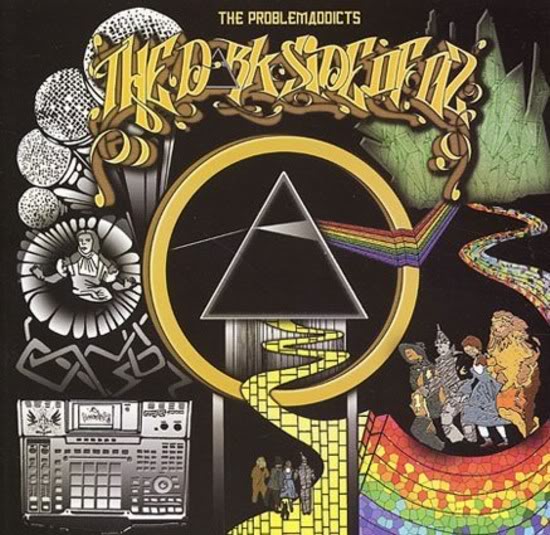
The Problemaddicts - The Dark Side of Oz


A mere two years following their founding in 2006, 6-man crew The Problemaddicts undertook a project that pulled together two albums that had already coexisted comfortably in smoky dorm rooms around the world for more than 40 years: Pink Floyd's Dark Side of the Moon (1973) and "The Wizard of Oz" soundtrack (1939). As one might imagine, such an unoriginal pairing could produce one of only two outcomes: Groundbreaking or Heartbreaking. As it should already be obvious from its inclusion here, the release of The Dark Side of Oz put to rest any question of The Problemaddicts falling prey to any pitfalls that may have led to the latter. Never before has a 40-year-old concept sounded so fresh and current.

Much more than a mash-up of already-made masterpieces, The Dark Side of Oz takes elements from many source materials, including interviews with Pink Floyd, an anti-drug George W Bush speech, and plenty of other playful audio pieces-parts, which all come together with precision-cut production similar to Gorillaz or Handsome Boy Modeling School. What The Problemaddicts bring to the table is a wholly-new hodgepodge of hedonistic helpings of hip-hop goodness; and it'll keep you coming back for more. The beats are built organically over repeating riffs mined from Dark Side of the Moon. The rhymes are dropped like pennies from heaven, falling end-over-end, flipping and turning, becoming more and more dangerous as they approach the masses below, yet brilliant and rich nonetheless. Think Wu-Tang. No, I'm not really comparing The Problemaddicts to the untouchable greatness of The Wu (R.I.P.O.D.B.), but the lyrical flow of The Dark Side of Oz lays a little looser in the groove than much of today's click-tracked, on-the-beat borefests. There's something "old school" about it, like something you might've seen stacked between Spice 1 and Run DMC on "Yo! MTV Raps" back in the day.

This is an immensely complex album that could have imploded at a hundred different points along the production path, but it didn't. (Just one advantage of being addicted to problems, I guess.) Instead, this wise-cracking crew from Massachusetts (yeah, you read that right - MASSACHUSETTS) took on the task of breathing new life into old classics, and as Dr. Frankenstein would say, "It's alive!" Best of all: You can preview the whole album right here: http://www.last.fm/music/The+Problemaddicts/The+Dark+Side+Of+Oz. And like your old standardized test instructor used to warn before each section, "Do not skip ahead". This album is like the Yellow Brick Road, the fun is in the journey. The inclusion of poppies are entirely up to you.

Highlights: "Somewhere" and "Home"

Friday, August 20, 2010

Lost In The Trees - All Alone In An Empty House


Shh. As the title of the album suggests, this is best heard "All Alone in an Empty House". Normally, I tend to be drawn to simple music that makes the most of its melodies, whose sum truly outperforms its parts. But then there are multi-instrumental masterpieces like this one that start simple, before stepping outside and bringing back a bit more of the world to share. Lost In The Trees captures a brilliance and beauty that has been left behind by most of their contemporaries. The songs that make up All Alone in an Empty House aren't so much subdued as they are subtle. Sure, there's a quietness to each song that can't be denied, but there's also a creativity that can't be contained. It's a creativity that is both calculated and at the same time completely carefree. Between the finger-picked guitars and swelling orchestration, the balance that exists extends beyond the well-trodden plane where most performers plant their feet. This album is not so much a glimpse into the mind of the musician as it is a black hole of human emotion that sucks in its surroundings like a banshee breathing in reverse, signaling signs of life rather than impending doom.
As a classically trained composer at the Berklee School of Music in Boston, MA, frontman Ari Picker plows through each song like a balladeer on Benzedrine, melancholic and on a mission. Each song seems to draw power from places most of us can't even point to. To call Mr. Picker a "prodigy" would be to say that The Beatles were "experimental". Much in the same way that Lennon and company pushed the limit of pop music, Lost In The Trees tests the tried-and-true notions of music itself. Attesting to its brilliance is the fact that All Alone In An Empty House was originally recorded and released back in 2007, while Picker was still in school; however, since being signed to Anti- records, the album has been given a grand re-entrance on a much more sizable stage, complete with additional songs and remastering. While there are certainly some similarities with new label mates The Swell Season, Lost In The Trees stands alone in their own realm, in their own room, in their own empty house, as a troubled soul with too much talent to waste and too much time to reconsider the wrongs in life that were never made right. These songs haunt my soul as assuredly as they inspire it. Hearing it for the first time is like waking up from a dream and finding that the other side of the bed has been abandoned: Freedom filled with fear. You place your hand upon your partner's still imprinted pillow, and the band begins to play...

Highlights: "Walk Around The Lake" and "Fireplace"

Wednesday, August 11, 2010

J Roddy Walston And The Business (self-titled)

All hail the rebirth of Southern Rock sensibilities! J Roddy Walston fuses together dirty blues beats and even dirtier rock runs, creating a raw and raucous album that rolls in like a rush of blood to all the right places. J Roddy Walston and the Business's debut album is everything I ever wanted out of a Jack White album, minus Jack White. Instead, Walston and his Business partners come across as something of a Black Crowes/White Stripes love-child. The resulting album is track after track of loud, proud, pissed-off, right-on rock and roll. You can almost hear the hoarseness growing in J Roddy's vocals as the album advances.

J Roddy Walston and the Business just may be the greatest "bar band" of all time. From the opening piano part of "Don't Break the Needle", you just NEED a beer to fully appreciate all that this album has to offer: a whole damn house party packed into a 37.7-minute mesmerizing, messy masterpiece. The vocals veer high and low like a man who's visited the verge of Hell in his earlier days and now vacations there during down times. The guitars are gritty, gained-up and grab hold of your gut like a pitbull that can't-for-the-love-of-god let go. The percussion pivots from piano to 5-piece kit without so much as a pause, giving the band a broader base by which to build their own brand of southern symphonies. It all comes together in a cohesive collaboration of sonic screams sung to down-home ditties. This kind of rock n roll is why vinyl records and jukeboxes still exist. This isn't one of those albums that I want everyone to hear; it's one of those albums that everyone needs. I repeat: You need this album. Go get it! Now. I promise you won't be disappointed.

Highlights: "Don't Break The Needle" and "Don't Get Old"

Tuesday, June 29, 2010

Lissie - Catching A Tiger


It's a rare occasion that I stumble upon a new artist whose voice grabs hold of me so tightly as Lissie's voice; it's raspy, sexy, pitch-perfect, and yet not at all pretentious. On her debut album, Catching A Tiger, Lissie lays the groundwork for a career as open as the rural landscapes she recounts in her songs. She could be the next Cheryl Crow. She could turn country and become a new Jewel. Hell, given some of her cover song choices I've heard, "Bad Romance" (Lady GaGa) and "Nothing Else Matters" (Metallica), it's really hard to say where she's headed next. For the time being, I'm hoping that she just continues to pump out more of the Southern-infused folk rock that makes up this entire album. At times beautiful, at times grungy, at times as classic as classic rock gets, Lissie spans the spectrum of musical influences without sounding anything like them. Okay, that's not entirely true; anyone with an ear can hear some distinct throwbacks to bands like Lynyrd Skynyrd, Fleetwood Mac, John Cougar Mellencamp, and others. Hailing from Rock Island, Illinois (pop.39, 684), Catching A Tiger echos the small-town/big-city playfulness that is so prevalent in its songs. Whether you like blues, rock, pop, or folk, you will find something new to love in this album and this artist. I really just can't say enough good things about her. I'm expecting great things in the future from first-name-only Lissie.

Highlights: "When I'm Alone" and "Everywhere I Go"

Thursday, April 1, 2010

Elliott Smith - Figure 8


Figure 8 is an important release in the Elliott Smith discography for a number of reasons: 1) It's the last record he released before his death, 2) It's his last release under his DreamWorks contract, 3) It's his most musically exploratory release , and 4) It's the last release before Smith's drug dependencies began to interfere with his music, rather than just influence it. For those of you who've never listened to an Elliott Smith album before, you're in for a real treat. He plays unfolky folk music. He plays unrockish rock music. He plays unpunk punk music. His approach to songwriting was guided by two major components: melody and mood. As such, it's not hard to hear the Beatles fan in him hanging out in the corner of almost every composition. Smith's lyrics really leaned more toward poetic than pop aesthetics, delivered in a whispery rasp that he developed during the later years with his previous band, Heatmiser. (If you do decide to wander into the Smith back catalog, be warned: Though Smith was a frontman for Heatmiser, his solo work bears little resemblance with that band's five releases, except for maybe Mic City Sons.) And while I have a special place in my heart for all of Elliott Smith's albums, Figure 8 is my favorite. It's a bit like saying that I love this orange more than that one, but there it is. Although sometimes criticized for being "too glossy", especially for a guy whose entire repertoire reveled in its rough-around-the-edges executions, Figure 8 seemed to capture a moment in time when Smith was working at expanding his sound with experimental abandon. Having just come off the huge popularity of X/O (which had followed an Oscar nomination for "Miss Misery" from the Good Will Hunting soundtrack), Smith intentionally nudged this new material in another direction. Swelling orchestrations, intricate chord progressions, and meticulous melodies make Figure 8 one of the most beautiful albums ever recorded. Like a modern-day Simon and Garfunkel humming harmonies with himself.

Highlights: "Son of Sam" and "Everything Means Nothing To Me"

Wednesday, March 24, 2010

The Tom Fun Orchestra - You Will Land With A Thud


Aside from having one of the coolest album titles ever, these guys make some of the coolest music off the mainstream path. To sum them up in a word, The Tom Fun Orchestra is a "blender" band. They cull their musical influences from such vast and far-reaching genres (folk, rock, country, blues, roots) and artists (Tom Waits, for sure) that their resultant sound is one unlike anything you've ever heard before. No doubt, you'll recognize pieces and parts of myriad hitmakers who have come before them, but Tom Fun Orchestra puts all those pieces and parts back together in an odd and refreshing way that leaves you feeling a little confused, like maybe this music is a little too hip and cool for you, but then you realize that there's a nerdiness to it all that seems to open its arms like a giant bearhug holding all the world together as one. Okay, that may be overstating it just a bit, but you get the point nonetheless. What I'm trying to say here is that the music is so inclusive of conflicting genres and song structures that it excludes no one from its potential pool of listeners. If the vocals come off a little rough at first, just give it a few more minutes, it'll grow and change. And that seems to be the constant theme of the album: "growth and change." Every song has its own little existence and groove, but yet they all fit perfectly onto the collective album. And it's no mistake that the word "fun" is part of the band's name; this is a party album! They're not all hooks and grooves and bouncing basslines, (in fact none of them are) but rather just good, fun, upbeat-tempo, get-off-your-bum-and-try-something-new type of tunes. I've listened to this album for weeks at a time over the last few years, and it never gets old - it never even gets older. It's just as fresh, fun and new as the first day I picked it up. Goes well with Crooked Fingers and a party hat... and a feather boa... and a glass of champagne... and jelly beans. In short, don't bottle it up in a pair of headphones; let this one breathe.

Highlights: "When You Were Mine" and "Throw Me To The Rats"

Tuesday, March 23, 2010

Have Gun, Will Travel - Postcards From The Friendly City


Just released in February, this is perhaps the most recent selection to hold my heart captive. Mostly well-defined by the term "folk", Postcards From The Friendly City has something else going on, which may be called "alt-country" in some circles, even though it's more progressive than most alt-country bands that exist today. Reminds me a good deal of the Deer Tick War Elephant album I posted a few weeks back, which isn't terribly surprising, given that both bands are signed to Suburban Home Records, who also represents some of my other favorite singer/songwriters Chuck Ragan and Tim Barry. (Note to readers: If you ever find an indie band you like, always check out who else is on their label - there's likely a few more you'll enjoy. Saddle Creek Records is a good example.) Hailing from Tampa (I know, who'd have thought?), Have Gun, Will Travel (HGWT) have a sound more representative of Memphis than mid-Florida. What's interesting is that this band just sort of came together with one member at a time, creating a fuller sound with each new player. Those players are: Matt Burke (voice, guitar, harmonica, occasional banjo), Daniel Burke (stand-up/elec. bass, voice), JP Beaubien (drums, percussion), Joshua "The Violation" Hernandez (viola, mandolin), and Scott "Fats" Anderson (elec. guitar, lap steel). The lyrics are really honest, the music is pretty straight-forward, and all of the songs are played in a really loose, live sort of way, which seems to capture the essence of HGWT pretty well. This isn't big music for a big venue, but rather exactly what I have in mind when I think of the perfect bar band, and I don't say that as an insult at all. What I mean is that these are really well-crafted, thoughtful songs that are better suited to a smaller, more thoughtful audience, that's all. And I must warn you: It's a catchy album! So, if you're the kind of person who tends to hear a hook and hum it out loud the rest of the day, just beware. Goes well with The Felice Brothers, The Avett Brothers, or just about any other brotherly bands.

Highlights: "Salad Days" and "Asa Dalton"

Tuesday, February 23, 2010

Paul Westerberg - Suicaine Gratifaction

Following his time as leader of indie-rock icons The Replacements, Paul Westerberg took to releasing more radio-friendly pop hits as a solo artist, and his success was immediate. Before he could even compile an entire album, Westerberg found fame providing the score for the film Singles, for which he also contributed his most well-known-to-date singles "Dyslexic Heart" and "Waiting For Somebody". These songs would later also appear on his 1993 solo debut, 14 Songs, which bears little resemblance at all to what would be his third solo album, Suicaine Gratifaction. Released just six years after the success of Singles, the songs of Suicaine Gratifaction revealed a deeply personal glimpse of Westerberg's inner demons and insecurities. Widely known for his wry wit and self-deprecating humor, Westerberg went about the writing of this album by bearing whatever soul his pen could provide at the time, and the recordings capture every chord (and discord) his muse could muster. Truthfully, this is in fact the most personal album I've ever heard by any major artist. Toned-down productions that often seem to be secured from a single take, this album is full of emotional breakdowns beaten back by upbeat breathers that keep it from falling apart completely. While Westerberg sometimes seems like the kind of songwriter whose songs might fare better in a friendlier voice, there's no substitution for the real connection the artist shares with his work; someone else could sing the lyrics, but few could feel the weight of Westerberg's words. His first and only release under contract with Capitol Records, Suicaine Gratifaction received little (if any) marketing support, resulting in no single for the album and sales that slipped before they even started, which all contribute to making this one of the greatest diamond-in-the-rough finds of all time. The songs are beautiful (even in Westerberg's sometimes beastly bear-growls), and no matter how many times I listen to them, they always seem to find new ways for me to identify with them. As far as hearts on sleeves go, this is verbal voyeurism at its very best. Go get a copy.

Highlights: "Lookin' Out Forever" and "Tears Rolling Up Our Sleeves"

Friday, February 19, 2010

Rage Against The Machine (self-titled)

Let's be clear: This particular pick is NOT everyone's cup of tea, and I respect that; however, since my goal of this blog is to promote albums that I feel EVERYONE should hear, I'd be derelict in my duty if I excluded it based on popular tastes. Whether you appreciate music as loud and vulgar at times as Rage Against the Machine, the fact remains that this band (with this album) changed what was happening in music at that time (1992). Unlike most musical trends and emerging genres, there weren't a lot of Rage Against the Machine copycat bands that followed, leaving the band in a class all their own. Blending and bending genres ranging from metal to funk to rap, rock, reggae and everything else in between, RATM wasn't just taking on the American government, they were taking on the American music culture. Incorporating politically-charged lyrics with grunge-rock grooves and earth-pounding percussion, this band boldly went were no band had gone before, and achieved a level of success that few bands this heavy ever will. Don't make the mistake of lumping this band together with the lump-headedness of most 90s metal meatheads! RATM contains some of the most intellectual and creative lyrics I've ever heard. This isn't just a band full of rage, they're a band full of righteousness. In a genre filled with angry mama's boys and misfits, RATM members Zack de la Rocha, Tom Morello, Tim Commerford, and Brad Wilk were the "real deal"; Morello was himself a Harvard grad who worked as an aide to Democratic Senator Alan Cranston prior to joining the band. They talked the talk louder than anyone else out there, but they also walked the walk, even if that meant getting arrested for inciting riots now and again. RATM was one of the few bands since the sixties that led a charge of change and actually had a chance of achieving it. I first heard these guys play as the first band on the bill at Lollapalooza 93 in New Orleans. The show opened with an elderly woman raising her middle finger to the crowd and asking us to join her in chanting "F... the New Orleans Police Department". As an angst-ridden teenager, I was instantly hooked. As I review the album some 18 years later, I realize that as a teenager I hadn't even begun to understand the true power this band possessed. For anyone who's ever felt fearful that America is just an "old boy's club" disguised by democracy, this band's for you.

Highlights: "Wake Up" and "Freedom"

Friday, February 12, 2010

Rilo Kiley - More Adventurous

Aside from being the album that catapulted Rilo Kiley from the indie scene into the mainstream, More Adventurous was exactly what the title suggested: An adventure into variations of sounds unseen in the band's prior releases. In fact, as Rilo Kiley's third full-length album, you get a glimpse into the band's past sound, as well as a look ahead to what would become their next album, Under The Blacklight. For a band that never hit a sophomore slump, they came out swinging with More Adventurous, like they were out to prove themselves somehow. Even now, I don't know what they were trying to prove, but they succeeded, and I'm a believer. More Adventurous doesn't have a bad track on it. No filler tracks. No b-side speedbumps. Frankly, I'm surprised that the physical CD can support the weight of the content on this album; the songs are that heavy. Released not long after the suicide of Elliott Smith (whose music we'll feature soon), two of the songs ("Ripcord" and "It Just Is") were written with his loss in mind. The lyrics are thoughtful and genuine, the music is carefully constructed, and the production is perfectly balanced between polished-up and stripped-down. Led by the bright, beautiful voice of Jenny Lewis, there's enough going on here for anyone to appreciate it. Be sure to check out any and all side projects related to the members of this band; it's all good.

Highlights: "It's A Hit" and "Accidntel Deth"

Wednesday, February 3, 2010

Various Artists - Dream With The Fishes (Original Motion Picture Soundtrack)


Not as hard to find in this digital age as it once was, the soundtrack for the film Dream With The Fishes is well worth the digging. Much in the same way that the films Singles and Almost Famous (yes, I realize those are both Cameron Crowe examples) were told through the music within them, this soundtrack helps move the story along, making it a story in and of itself. After scouring various record shops for nearly two years, I finally found this gem hiding out in the French Quarter of New Orleans, which is strangely appropriate given the tone of the album. That said: If you're looking for an upbeat, party mix, keep looking - this ain't it. Blending variations in mood that range from somber to dark to melancholic to depressing, Dream With The Fishes is an album that requires the right atmosphere. Now, if you find yourself in the mood for such feelings, you won't find a better album out there. Best of all, it's not jam packed with a bunch of unrelated hit songs you already own; in fact, I'd be surprised if you own a single album from more than two or three of the artists featured here. Needless to say, this album kept me running back and forth to the record store, trying to find more related music. (Though not featured on the soundtrack, it was Dream With The Fishes that originally introduced me to Son Volt's "Ten Second News" from their Trace album, which I wrote about last week.) There's a lot of music to be discovered for anyone who isn't already a "music person". Might not be for everyone, but for those who are open to it, there might not be anything that compares.

Highlights: Nick Drake's "River Man" and Waterboys' "Fisherman's Blues"

Friday, January 29, 2010

Deer Tick - War Elephant

Not only do I not remember where I first picked up Deer Tick's War Elephant, I also don't know what it is about the album that has kept me so drawn to it ever since. Of course, I wouldn't take the time to blog about it here, if it weren't a great album, but that's hardly what I'm talking about when I say that its attraction eludes me. Without even getting into the discussion of what constitutes good music or bad music, there's another level to music (any music - good or bad) that exists, and that is the draw. Sometimes, the draw is synonymous with originality, but sometimes it's something else entirely. In the case of this particular album, its draw is its production: just dirty enough to match the songs. The tracks feel like they've been pulled right from the soundboard of a corner bar concert that was played in some sleepy town on Saturday night. Just the kind of show you'd stumble into on accident and end up having one of the best nights of your life. Now, what's really cool about this band is that it's one guy, John Joseph McCauley III. Well, at least on the War Elephant album anyway; the band has since grown into a 5-piece group. While listening to the album though, just keep McCauley in mind - one guy, alone in a studio, laying down track after track, not knowing what it would all sound like when it came together in the end. With his gritty guitar style and even grittier singing, McCauley's Deer Tick has a sound unlike any others. It's part country, part rock, part folk, and all good. The other thing to look for is the diversity of the album. While most of the tracks find themselves swimming in the same vein, you'll find a few songs sliding off into the superunknown in terms of style. In the end, I'm left wondering where this band can't go.

Highlights: "Long Time" and "These Old Shoes"

Thursday, January 28, 2010

The Killers - Sam's Town

This album gets a lot of flack, and I have no idea why, though I am comforted in knowing that I am not alone on this issue. In a December 2009 poll of Rolling Stone readers, Sam's Town was hailed as the most underrated album of the decade. (And just when I think Rolling Stone has completely lost its sense of good music! See their review of this album from 2006 for evidence.) Aside from being somewhat of a complete departure from the band's glam-emo-electronic debut album, Sam's Town is somewhat of a complete departure from everything else that was released by any artist at that time. With this release, The Killers gave listeners something of a back-to-the-drawing-board approach to the traditional rock n roll album, which sounds like it would be right at home in a 100,000+ arena setting. All of the songs have such a huge presence, it's as if the band were building a town of their own, and this album is their account of the town's journey from birth to death. You can't help but settle in and start to feel right at home in the howling dust winds swirling all around this hot desert wasteland. What I love about The Killers is their ability to take simple parts and put them together in complicated and completely new ways, so that a single-note guitar strike looping over and over suddenly becomes the spine of an epic swell of sound that sweeps inland, gathering emotional intensity from each new inch of the world it washes over. Make no mistake about it: This is not just a record; it's a ride - so buckle up. Borrowing a bit of inspiration from the greatest American artists of their time, Sam's Town sounds at times like a really good Tom Petty, Bruce Springsteen, or Neil Young album that you've never heard before. The songs are genuine in theme, yet unapologetically grand in style. Don't sell this album short by sticking to the singles; Sam's Town is meant to be heard in its entirety - one track followed by the next. Welcome to Sam's Town; I hope you enjoy your stay.

Highlights: "When You were Young" and "Read My Mind"